Choosing the right amount of auto insurance coverage is one of the most important financial decisions you’ll make as a driver. Too little coverage can leave you personally responsible for thousands of dollars in damages or medical bills. Too much coverage or the wrong type can mean paying for protection you don’t actually need.
The right answer depends on your vehicle, your finances, and your personal risk tolerance. This guide walks you through each factor so you can make a confident, informed decision.
If you want to see how different coverage levels affect your premium, use our Auto Insurance Cost Calculator.

Use our free calculator to estimate potential costs based on age, vehicle type, and coverage level.
Table of Contents
Auto insurance isn’t just a legal requirement — it’s a financial safety net. A single at-fault accident can result in liability claims, vehicle repair costs, and medical expenses that far exceed what most people can pay out of pocket.
InsuranceBlip content is created by researchers and reviewed using publicly available insurance data, regulatory resources, and industry research. Our goal is to provide clear, unbiased insurance education.
Every state requires drivers to carry a minimum level of liability insurance, but meeting the legal minimum doesn’t mean you’re adequately protected.
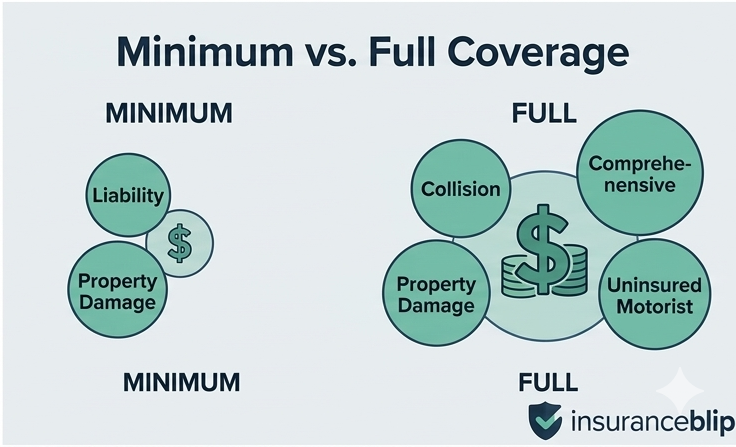
For a detailed breakdown, see our guide on Minimum vs. Full Coverage Auto Insurance.
There’s no one-size-fits-all answer, but these factors will guide most coverage decisions.
Most insurance professionals suggest going beyond state minimums when you can afford to. While needs vary, the following is a useful starting framework:
These are guidelines, not rules. Your specific situation may call for more or less.
Full coverage generally meaning liability plus collision and comprehensive is worth considering when:
Minimum coverage may be a reasonable choice when:
Coverage decisions involve a real trade-off: lower premiums mean more out-of-pocket exposure if something goes wrong, while higher coverage means better protection at a higher monthly cost.
Most drivers find their balance by:
Because insurance pricing varies widely, calculators can help you estimate realistic costs based on age, vehicle type, coverage level, driving record, and location.
Drivers often make one of a few avoidable mistakes:
Taking a few minutes each year to review your coverage can improve both your protection and your cost efficiency.
Every coverage decision you make has a direct impact on your premium. Higher limits, lower deductibles, and added protections all increase your cost, but they also increase your protection.
Learn more in our guides on How Much Auto Insurance Costs and 10 Factors That Affect Auto Insurance Rates.
You can also estimate your costs using the Auto Insurance Cost Calculator.
Try Auto Insurance CalculatorExplore Insurance GuidesYou may also find these tools helpful:
InsuranceBlip provides educational content only and does not sell insurance products. The information on this site is not personalized financial advice. Please consult with a licensed insurance professional for advice specific to your situation.
© 2026 InsuranceBlip. All rights reserved.