Estimate your monthly auto insurance cost based on your age, vehicle, driving history, and coverage level. No personal information required.
Educational estimate
No signup required
Free tool
FREE • NO SIGNUP • EDUCATIONAL ESTIMATE
Auto Insurance Cost Estimate
Estimate your auto insurance costs using common pricing factors. No personal information required.
✓ Educational estimate✓ No signup✓ No quotes
Your Estimated Auto Insurance Cost
$—
estimated monthly range
Educational estimate
Monthly Estimate$—estimated range
Annual Estimate$—estimated range
CoverageStandard Coverageselected level
Important: This calculator provides an educational estimate only. Actual premiums vary by insurer, state, ZIP code, vehicle details, policy limits, discounts, driving history, credit-based insurance score where permitted, and other underwriting factors.
How This Auto Insurance Calculator Works
This auto insurance calculator provides a general estimate of how much you might pay for car insurance based on common rating factors used by insurers.
Insurance companies calculate premiums using many variables such as driver age, vehicle type, coverage level, driving history, and location. Our calculator uses these widely known factors to generate a realistic cost range.
Because insurance companies use different pricing models, the results shown are estimates rather than exact quotes. The goal of this tool is to help you understand how different choices can affect your potential insurance costs before you shop for coverage.
The calculator does not require personal information and does not generate quotes from insurance companies.
What Factors Affect Auto Insurance Costs?
Several key factors influence how much drivers pay for auto insurance. While the exact formulas vary between insurers, most companies consider similar core variables when calculating premiums.
Driver Age
Younger drivers typically pay higher premiums because they have less driving experience and statistically higher accident rates. Insurance costs often decrease as drivers move into their mid-30s and 40s.
Vehicle Type
The type of vehicle you drive affects insurance costs. Vehicles that are more expensive to repair, more powerful, or statistically involved in more claims may cost more to insure.
Coverage Level
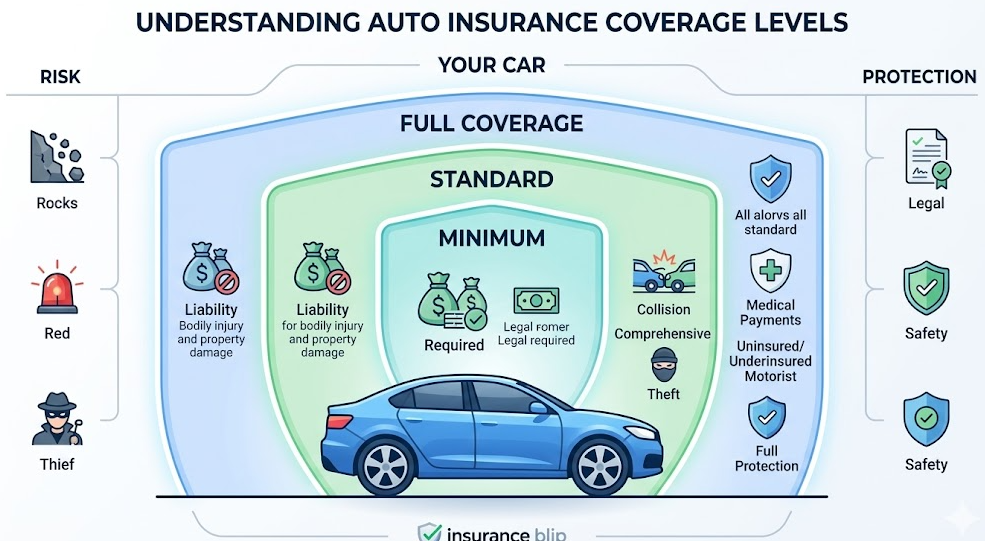
Minimum coverage policies usually cost less but provide limited protection. Full coverage policies include additional protection such as collision and comprehensive coverage, which increases premiums.
Driving History
Drivers with clean records typically receive lower premiums. Traffic violations, accidents, or previous claims may increase insurance costs.
Location
Insurance costs vary significantly by location. Urban areas with higher accident rates, theft risk, or repair costs may have higher average premiums than rural areas.
Why This Calculator Shows a Cost Range
Insurance companies calculate premiums using their own proprietary models. Even drivers with similar profiles may receive different quotes depending on the insurer.
For this reason, the calculator provides a cost range rather than a single price. The range reflects typical pricing variation between insurance companies.
The estimate should be used as an educational reference to understand potential costs and how different factors influence pricing.
When an Auto Insurance Calculator Is Useful
An insurance cost estimator can be helpful in several situations:
When budgeting for a new vehicle
When comparing different coverage levels
When planning for insurance costs before moving to a new state
When evaluating how driving history might affect premiums
When learning how insurance pricing works
Using a calculator before requesting quotes can help you make more informed insurance decisions.
Related Tools
The auto insurance tool ecosystem
Explore our featured tools related to auto insurance.
Coverage Comparison Tool
Compare minimum coverage vs full coverage to see the real cost difference & what each option actually protects.
Coming Soon
Discount Finder
Answer 5 quick questions about your driving habits and profile to find which auto insurance discounts you currently qualify
Coming Soon
Deductible Impact Calculator
See exactly how changing your deductible from $500 to $1,000 or $1,500 affects your monthly premium — before you decide.
Coming Soon
Auto Insurance Special
How Much Could You Save by Switching Insurers?
Many drivers pay more than they need to — not because cheaper coverage does not exist, but because they have never compared. Studies consistently show that drivers who compare quotes from at least three insurers save an average of $400–$700 per year for identical coverage. The savings potential depends on your profile.
Driver Profile
Avg. Annual Overpayment (not comparing)
Young driver (18–25)
$600–$1,200/year
Driver with one at-fault accident
$400–$900/year
Driver in high-cost state (FL, MI, LA)
$500–$1,000/year
Driver with poor credit (where permitted)
$600–$1,400/year
Driver who has not compared in 3+ years
$300–$700/year
Note: These figures reflect the typical premium gap between the highest and lowest quotes available for the same driver profile and coverage level. Insurers reprice risk constantly — a rate that was competitive when you last bought may no longer be the best available today.
Frequently Asked Questions
Is this auto insurance calculator accurate?
his calculator provides an estimate based on common rating factors used by major US auto insurers — age, driving history, vehicle type, coverage level, and location. When inputs are accurate and complete, results typically fall within 15–25% of actual insurer quotes for your profile. It is a planning tool — use real quotes from licensed insurers before making a final coverage decision.
Does this tool provide insurance quotes?
No. This is an educational estimate tool, not a quote engine. A real quote requires an insurer to verify your driving record (MVR), claims history (CLUE report), and in most states a credit-based insurance score. Use this calculator to understand your cost range and set a budget — then request real quotes directly from insurers or through a comparison tool.
Do I need to enter personal information?
No personal information is required. The calculator uses general inputs — age range, state, vehicle type, coverage level, and driving record — to generate your estimate. No name, email, license number, or payment details are collected.
Why do insurance prices vary between companies?
Each insurer files its own premium rates with state regulators based on its own claims experience, risk models, and administrative costs. An insurer that has paid out heavily on claims in your zip code may price that area significantly higher than a competitor with less exposure there. This is why the same driver can receive quotes that differ by hundreds of dollars per year for identical coverage — and why comparing at least three quotes is consistently recommended.
How can I lower my auto insurance premium?
The five most effective actions: (1) compare quotes from at least three insurers every 12 months — switching saves most drivers $300–$700/year; (2) raise your deductible from $500 to $1,000 — reduces premium 10–15%; (3) bundle auto with home or renters insurance — multi-policy discounts of 5–25% are common; (4) ask about every available discount — safe driver, low mileage, good student, and autopay discounts are frequently unclaimed; (5) maintain a clean driving record — a single at-fault accident can raise your rate by 40% or more for 3–5 years.
What is the difference between minimum and full coverage?
Minimum coverage (liability only) covers damage and injury you cause to other people and their property — it does not cover your own vehicle. It meets your state’s legal requirement but leaves significant gaps. Full coverage adds collision (your vehicle after an accident regardless of fault) and comprehensive (theft, weather, fire, vandalism). Full coverage costs an average of $95/month more than minimum nationally. Whether it is worth it depends on your vehicle’s current value — if your car is worth less than 10x your annual collision and comprehensive premium, dropping those coverages may make financial sense.
Related Guides
Continue Learning About Auto Insurance
Looking for more in-depth answers? Explore our latest auto insurance guides covering costs, coverage options, policy comparisons, and expert tips.
Secure your company's future with the right coverage. Quickly calculate estimated costs for general liability, property, and worker’s compensation based on your industry and team size.
Find out exactly how much coverage your family needs to stay protected. This tool analyzes your debts, income, and future goals to provide a personalized insurance target in minutes.
Protect your biggest investment without overpaying. Estimate your annual premiums based on your home’s value, location, and safety features to find a policy that fits your budget.
Get a clear picture of your potential healthcare costs. Use this estimator to compare plan types & see how different deductibles & coverage levels impact your monthly premium.
Quickly estimate costs for medical emergencies, cancellations, and lost luggage based on your destination and duration. Get the coverage you need to travel with total peace of mind.