Auto insurance is a contract between you and an insurance company that provides financial protection when something goes wrong with your vehicle, whether that’s an accident, theft, weather damage, or a liability claim from another driver. In exchange for paying a regular premium, your insurer agrees to cover certain costs up to the limits defined in your policy.
It’s one of the most common types of insurance in the United States, and for good reason: a single accident can result in thousands of dollars in vehicle repairs, medical bills, and legal expenses. Auto insurance exists to protect you from bearing those costs alone.
If you want to estimate what coverage might cost you, use our Auto Insurance Cost Calculator.

Use our free calculator to estimate potential costs based on age, vehicle type, and coverage level.
Table of Contents
InsuranceBlip content is created by researchers and reviewed using publicly available insurance data, regulatory resources, and industry research. Our goal is to provide clear, unbiased insurance education.
The basic mechanics of auto insurance are straightforward. You choose a policy, agree on coverage types and limits, and pay a premium, either monthly or annually. In return, if a covered event occurs, the insurance company steps in to cover the financial losses, up to your policy’s limits.
When something happens say, you’re in an at-fault accident, you file a claim with your insurer. Depending on your coverage, they may pay for repairs to your car, damage to the other driver’s vehicle, medical expenses, or some combination of all three. Before they pay, you’ll typically cover a portion of the costs yourself, known as a deductible.
The relationship works on risk transfer: instead of facing the full financial exposure of an accident yourself, you share that risk with the insurer by paying a predictable premium.
What your policy covers depends entirely on the types of coverage you’ve chosen. A basic policy might only cover damage you cause to others, while a more comprehensive policy can also protect your own vehicle against a wide range of events.
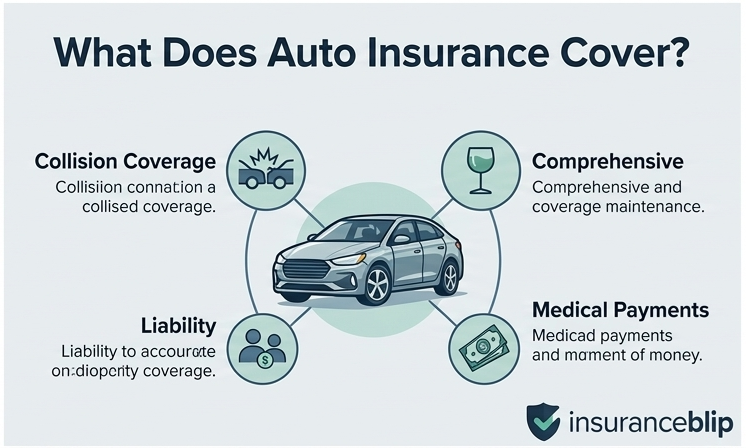
The most common coverage types include liability, collision, comprehensive, personal injury protection, and uninsured motorist coverage. Each one addresses a different type of risk, and they’re often purchased together to create a complete protection package.
For a full breakdown of each type, see our guide on What Auto Insurance Covers.
The most obvious reason to have auto insurance is legal. most states require it. But the financial protection it provides goes well beyond satisfying a legal requirement.
Without insurance, you would be personally responsible for every cost that results from an accident or vehicle incident. That includes repairing or replacing your own vehicle, covering the medical expenses of anyone injured, paying for damage to other vehicles or property, and defending yourself in a lawsuit if the other party decides to pursue one. A serious accident can easily generate costs well into the tens of thousands of dollars.
Auto insurance converts that unpredictable and potentially devastating financial exposure into a manageable, predictable monthly expense.
In almost every U.S. state, drivers are legally required to carry at least a minimum level of auto insurance before operating a vehicle on public roads. The specific requirements vary by state, but most mandate liability coverage, meaning insurance that pays for damage or injury you cause to someone else.
Some states also require personal injury protection or uninsured motorist coverage as part of their minimum requirements. New Hampshire and Virginia are notable exceptions with different rules, but even there, drivers who cause accidents are financially responsible for the damage they cause.
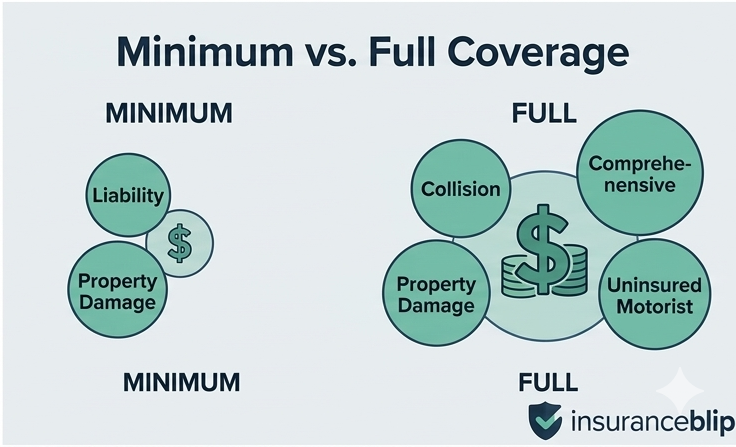
Meeting the minimum requirement keeps you legal, but minimum coverage often isn’t enough to fully protect your finances in a serious accident. Many drivers choose higher limits and additional coverage types for broader protection.
The cost of auto insurance varies significantly from driver to driver. Nationally, drivers pay anywhere from around $50 per month for minimum coverage to $300 or more per month for full coverage, depending on their profile.
Your premium is influenced by factors like your age, driving record, where you live, the type of vehicle you drive, and the coverage levels you select. Two drivers with identical cars can receive very different quotes because insurers weigh these risk factors using their own pricing models.
For a detailed look at what affects pricing, see our guide on How Much Auto Insurance Costs. You can also use our Auto Insurance Cost Calculator to get an educational estimate based on your profile.
Insurance companies calculate your premium based on how much risk they’re taking on by insuring you. Factors that typically influence your rate include:
Drivers with clean records, moderate-risk vehicles, and experience behind the wheel generally pay the least. Younger drivers, those with violations or accidents on their record, and drivers in high-cost urban areas tend to pay more.
The good news is that many of these factors can be influenced over time through safe driving, smart coverage choices, and regular policy reviews. For a full breakdown, see our guide on 10 Factors That Affect Auto Insurance Rates.
Understanding the main coverage types helps you make smarter choices when buying a policy.
Choosing the right auto insurance comes down to understanding your own situation. There’s no single “correct” policy, the right choice balances your budget, the value of your vehicle, how much financial risk you’re comfortable taking on, and what your lender requires if your car is financed.
A newer vehicle with significant value generally warrants full coverage. An older vehicle with low market value may not justify the added expense of collision and comprehensive. And if your savings could comfortably cover a major repair or replacement, you may be comfortable carrying less coverage than someone without that financial cushion.
For a step-by-step guide to making this decision, see How Much Auto Insurance Coverage Do I Need?
If you’re new to insurance, the terminology can feel overwhelming. Here are the key terms you’ll encounter:
Because insurance pricing varies widely, calculators can help you estimate realistic costs based on age, vehicle type, coverage level, driving record, and location.
If you’re buying auto insurance for the first time, the process can feel complicated. A simple approach: start by understanding what your state requires, then consider your vehicle’s value and your financial situation before deciding how much additional coverage makes sense.
It’s a contract where you pay a regular fee (premium) to an insurance company, and in return they help cover the financial costs if something happens to your vehicle or you cause damage to someone else’s.
Without it, you’d be personally responsible for all costs resulting from an accident, including vehicle repairs, medical bills, and legal liability. Those costs can easily reach tens of thousands of dollars. Insurance converts that risk into a predictable monthly expense.
In almost every U.S. state, yes. Most states require at least minimum liability coverage. The exact requirements vary, so check your state’s Department of Insurance for specifics.
Penalties vary by state but can include fines, license suspension, vehicle impoundment, and being held personally liable for all costs if you cause an accident.
Consider your vehicle’s value, your savings, your risk tolerance, and whether your car is financed. Our guide on How Much Auto Insurance Coverage Do I Need walks through this in detail.
Understanding what auto insurance is and how it works gives you the foundation to make smarter coverage decisions. Whether you're buying your first policy or reviewing an existing one, knowing how premiums, deductibles, and coverage types interact helps you balance cost and protection effectively.
You can also explore our Auto Insurance Cost Calculator to understand how coverage affects pricing.
Try Auto Insurance CalculatorExplore Insurance GuidesYou may also find these tools helpful:
InsuranceBlip provides educational content only and does not sell insurance products. The information on this site is not personalized financial advice. Please consult with a licensed insurance professional for advice specific to your situation.
© 2026 InsuranceBlip. All rights reserved.