Auto insurance premiums are not random. Insurance companies calculate rates based on risk factors that help predict the likelihood of claims.
Understanding what affects auto insurance costs can help drivers make smarter decisions and potentially lower their premiums over time.
If you want to estimate how these factors affect pricing, you can also use our Auto Insurance Cost Calculator to see how coverage choices influence insurance costs.

Use our free calculator to estimate potential costs based on age, vehicle type, and coverage level.
Table of Contents
ToggleInsurance companies use risk models to estimate how likely a driver is to file a claim. These models consider multiple personal and vehicle-related factors.
Some factors increase risk, while others may reduce it.
Each insurer weighs these factors differently, which is why quotes can vary.
InsuranceBlip content is created by researchers and reviewed using publicly available insurance data, regulatory resources, and industry research. Our goal is to provide clear, unbiased insurance education.
Age is one of the strongest pricing factors. Younger drivers typically pay higher premiums because statistics show they are involved in more accidents.
Typical trend:
Experience often matters as much as age.
A clean driving record usually results in lower premiums.
Insurance companies may increase rates after:
Drivers with multiple violations may be considered high-risk.
The car you drive significantly affects insurance pricing.
Insurance companies consider:
Typical pricing patterns:
Location affects insurance because risk varies by area.
Insurance companies may consider:
Urban areas often have higher premiums than rural areas.
The more protection you choose, the more insurance typically costs.
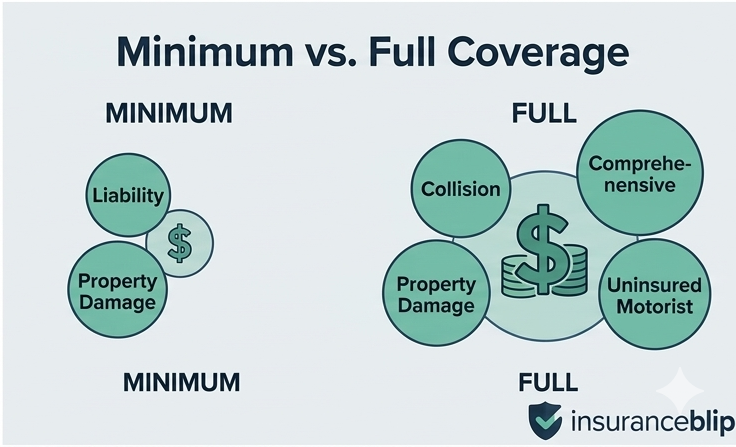
Minimum coverage usually costs less but provides limited protection. Full coverage costs more because it protects your vehicle as well.
Learn more in our guide on Minimum vs Full Coverage Auto Insurance.
Your deductible affects how much you pay monthly.
Many drivers choose deductibles based on savings and risk tolerance.
Drivers who spend more time on the road typically face higher risk exposure.
Drivers sometimes add extra protection such as:
Adding more coverage usually increases premiums because insurers take on more risk.
Drivers often balance:
You can estimate how coverage levels affect pricing using our Auto Insurance Cost Calculator.
Because insurance pricing varies widely, calculators can help you estimate realistic costs based on age, vehicle type, coverage level, driving record, and location.
Drivers can consider these questions:
Understanding risk tolerance helps determine appropriate coverage.
No. Insurance typically does not cover mechanical failure or maintenance issues.
Yes, if comprehensive coverage is included.
Yes, comprehensive coverage usually covers hail, storms, and natural events.
Yes, this is typically covered under comprehensive insurance.
No. Liability only covers damage you cause to others.
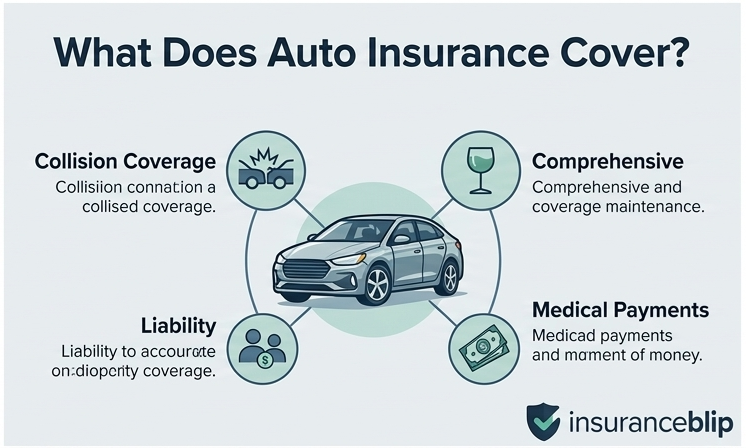
Understanding what auto insurance covers helps drivers choose policies that match their financial risk tolerance. While minimum coverage meets legal requirements, broader coverage can provide stronger protection against unexpected expenses.
Learning how coverage works allows drivers to balance cost and protection more effectively.
You can also explore one of our option from below:
Try Auto Insurance CalculatorExplore Insurance GuidesYou may also find these tools helpful:
InsuranceBlip provides educational content only and does not sell insurance products. The information on this site is not personalized financial advice. Please consult with a licensed insurance professional for advice specific to your situation.
© 2026 InsuranceBlip. All rights reserved.