Menu
Yes, in Most States. Here's How It Actually Works
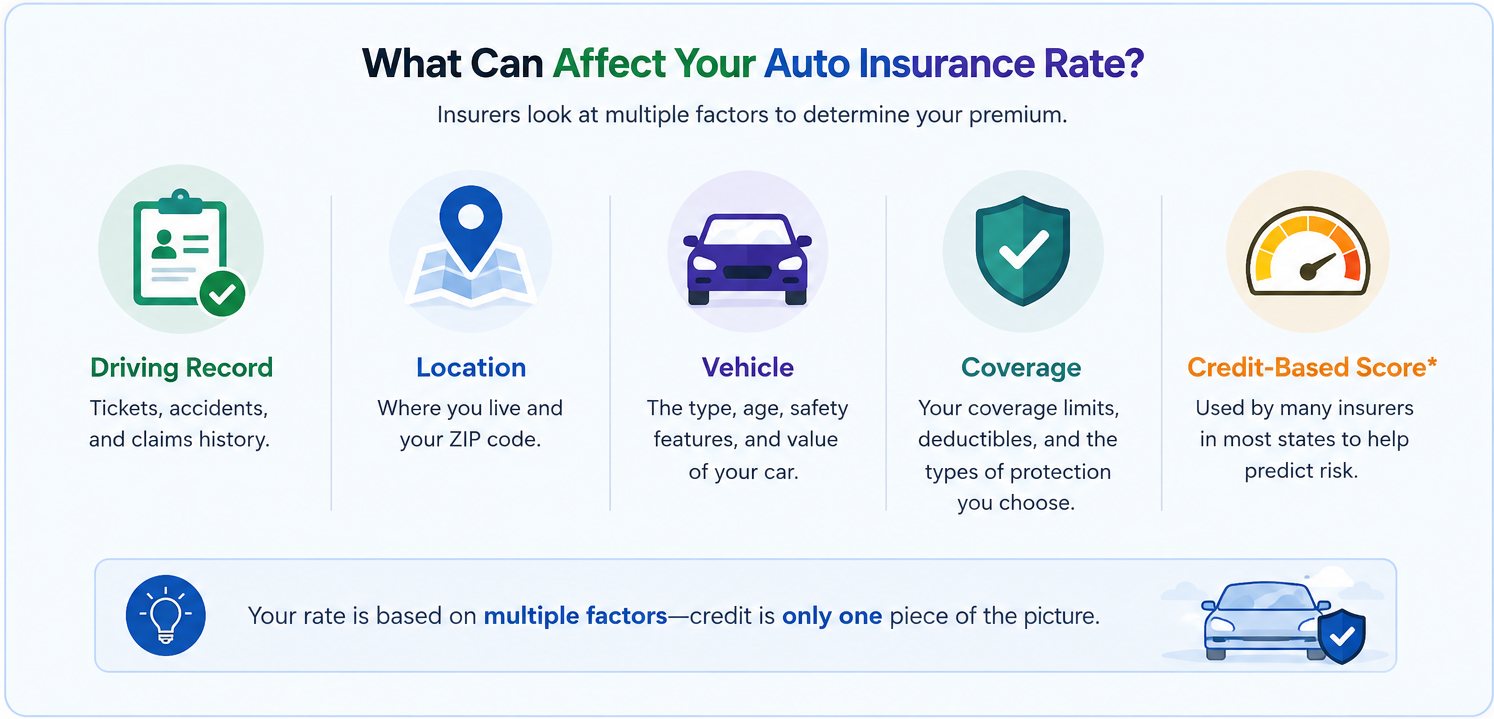
Yes, in most states. Insurers in the majority of the country use a credit based insurance score, a specialized calculation related to but distinct from your standard credit score, as one of several factors when setting your premium. Drivers with lower credit based insurance scores typically pay more, sometimes substantially more, than drivers with strong scores, even when their driving records are otherwise identical. For the full picture of every factor that shapes your premium, not just credit, see 10 factors that affect auto insurance rates.
This practice surprises many drivers who assume auto insurance pricing is based purely on driving history and vehicle type. In reality, insurers have found a statistical correlation between credit based insurance scores and the likelihood of filing a claim, which is the primary justification insurers give for incorporating it into pricing.
A credit based insurance score is calculated using some of the same underlying data as a standard credit score, such as payment history, outstanding debt, and length of credit history, but the specific formula insurers use is proprietary and weighted differently than a standard FICO score used for lending decisions. This means a driver could have a strong traditional credit score but a comparatively weaker credit based insurance score, or vice versa, since the two calculations are not identical.
Insurers combine this score with other rating factors including driving history, location, vehicle type, and coverage level to arrive at your final premium. Credit based insurance score is typically one factor among several rather than the single dominant one, though its specific weight in the overall calculation varies by insurer and can meaningfully shift your rate up or down compared to a driver with an otherwise identical profile but a different score.
Use our free calculator to estimate potential costs based on age, vehicle type, and coverage level.
Table of Contents
A handful of states prohibit or significantly restrict the use of credit based insurance scoring, based on concerns that the practice can disproportionately affect certain groups of drivers regardless of their actual driving risk.
Prohibits the use of credit history in setting auto insurance rates entirely.
Also prohibits the practice, joining California as one of the earliest states to ban it.
Bans credit based insurance scoring as a rating factor for auto insurance.
Restricts how credit information can be used, with specific limitations on its weight in the overall pricing calculation.
Drivers in these states are rated using other factors entirely, without credit based insurance score playing any role in their premium calculation. This is worth confirming directly with your state's insurance department, since rules can change and some states impose partial restrictions rather than a complete ban.
Several practical steps can help offset a lower credit based insurance score or reduce your overall premium regardless of where your score currently stands. Paying bills on time consistently and reducing outstanding debt both tend to improve credit based insurance scores over time, the same way they improve standard credit scores, since much of the underlying data overlaps between the two calculations.
Beyond credit specifically, maintaining a clean driving record, bundling your auto and home policies, raising your deductible, and comparing quotes from multiple insurers all remain effective ways to lower your premium regardless of your credit based insurance score. For a complete breakdown of every strategy available, see how to lower your auto insurance costs, since credit is only one lever among several you can actually influence.
Yes, in the majority of states, using credit based insurance scores as a rating factor is legal and has been upheld by state insurance regulators as a legitimate underwriting practice, based on the statistical correlation between credit history and claims likelihood. A small number of states have banned or restricted the practice specifically due to fairness concerns, making the legality of this practice dependent on your specific state.

No, typically not. Insurers generally use a soft inquiry to pull your credit based insurance score for a quote, which does not affect your standard credit score the way a hard inquiry from a loan or credit card application would. This means shopping for auto insurance quotes across multiple insurers should not itself damage your credit standing.
Credit based insurance score is a real and often underestimated factor in auto insurance pricing across most of the country, distinct from but related to your standard credit score. Understanding that it exists, confirming whether your state permits its use, and focusing on the factors you can directly control, including driving record, coverage choices, and comparison shopping, gives you a realistic path to a better rate regardless of where your credit currently stands.
Get an estimate that accounts for your driving history, vehicle, and coverage choices.
Try Auto Insurance CalculatorExplore Insurance GuidesAt A Galance
Use our free tools to estimate insurance costs before you shop. No personal information required just straight forward estimates.
Estimate your car insurance costs based on your age range, driving history, vehicle type, coverage level, & location. Understand how each factor affects your premium.
Calculate how much life insurance coverage your family might need based on your income, debts, and financial goals.
Understand how premiums, deductible, out-of-pocket costs vary across different plans. Useful for comparing coverage options during enrollment or life change.
Estimate general liability and small business insurance costs based on your industry, business size, and coverage needs.
Estimate how much homeowners insurance might cost based on your property value, location, and coverage needs.
Estimate trip protection costs based on your destination, trip duration, and the type of coverage you need.
© 2026 InsuranceBlip. All rights reserved. Website created & managed by Infolytics.