Menu
Two Kinds of Permanent Coverage, One Key Difference: Flexibility
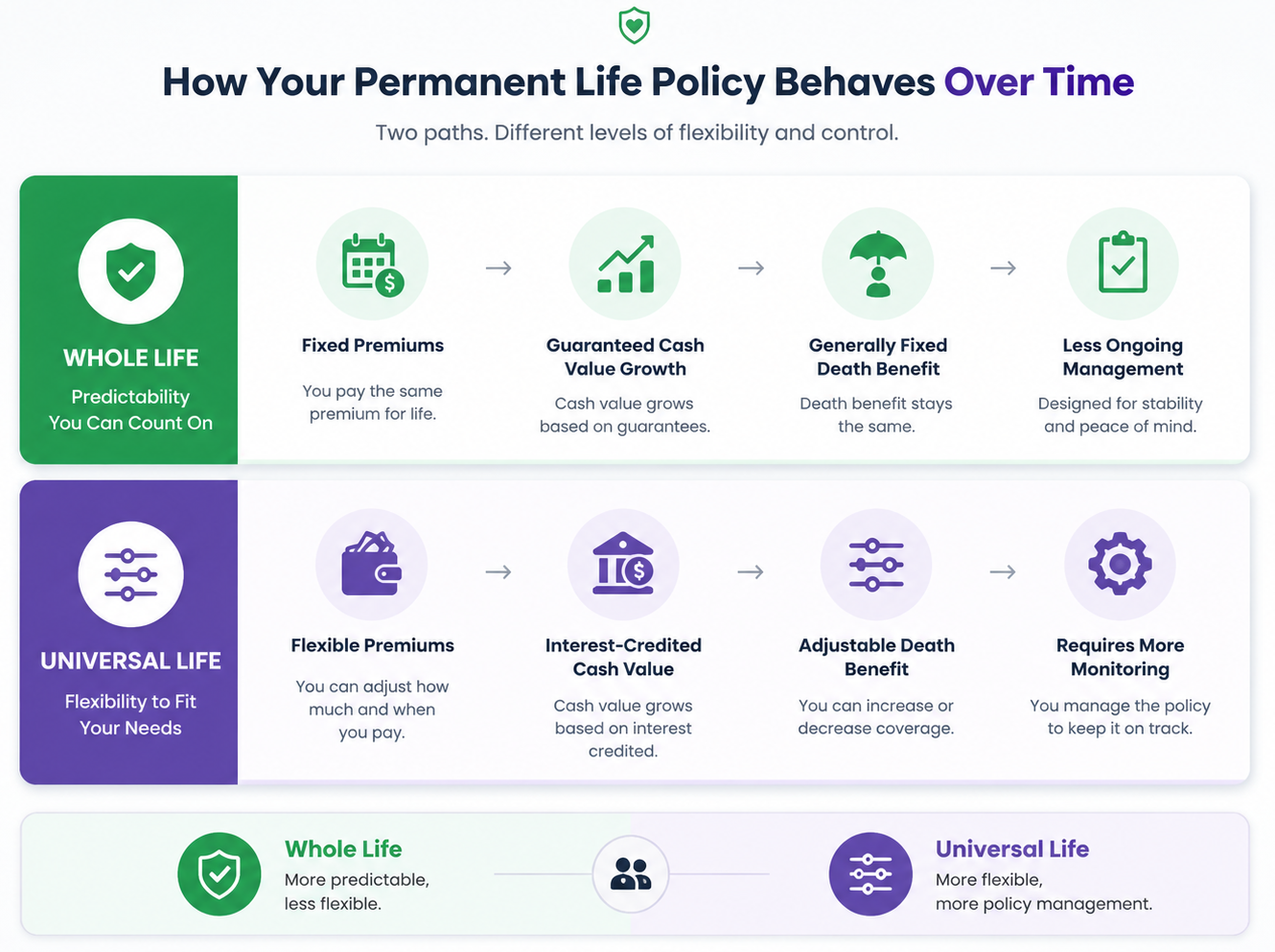
Whole life insurance offers permanent coverage with fixed premiums and a cash value that grows at a guaranteed rate, covered in full detail in term vs whole life insurance. Universal life also offers permanent coverage and cash value growth, but with meaningfully more flexibility, allowing you to adjust your premium payments and death benefit within limits over time, with cash value growth tied to a current interest rate the insurer declares rather than a single fixed guarantee. Variable life takes this further, allowing your cash value to be invested in sub-accounts similar to mutual funds, offering higher potential growth alongside real investment risk, including the possibility of losing value.
The core tradeoff across all three permanent policy types is the same: more flexibility and growth potential generally comes with more complexity and, in the case of variable life, genuine investment risk that whole life's guaranteed structure does not carry.
Universal life insurance separates your premium payment into two components: the cost of insurance itself and an amount that funds your policy's cash value. Within limits set by your policy, you can adjust how much you pay above the minimum required cost of insurance, and you can often adjust your death benefit up or down over time, subject to underwriting for increases, giving you meaningfully more flexibility than whole life's fixed premium structure.
Your cash value grows based on a current interest rate the insurer declares periodically, which can rise or fall with broader interest rate conditions, though most policies include a guaranteed minimum rate below which your cash value growth cannot fall. This structure means universal life's growth is less predictable than whole life's fixed guaranteed rate, but it can also outperform whole life during periods of higher interest rates, and the flexible premium structure can be genuinely useful if your income or financial priorities change significantly over time.
Variable life insurance takes the flexible premium structure of universal life a step further by allowing you to direct your cash value into investment sub-accounts, similar to mutual funds, that you select from options your insurer offers. This means your cash value growth is tied directly to how those underlying investments perform, offering the potential for meaningfully higher growth than either whole or universal life, but also carrying real investment risk, including the possibility that poor investment performance reduces your cash value.
Some variable policies, sometimes called variable universal life, combine this investment flexibility with universal life's adjustable premium and death benefit structure, offering the most flexibility and potential growth of any permanent policy type, alongside the most complexity and risk. This structure suits policyholders comfortable with investment risk and actively managing their policy, rather than those seeking the predictability whole life is specifically designed to provide.

See how much life insurance coverage you may need based on your income, debts, family needs, and financial obligations.
Table of Contents
| Term | Whole Life | Universal Life | Variable Life | |
|---|---|---|---|---|
| Coverage period | Fixed term | Entire life | Entire life | Entire life |
| Cash value | None | Guaranteed fixed growth | Growth tied to declared interest rate | Growth tied to investment performance |
| Premium flexibility | Fixed | Fixed | Adjustable within limits | Adjustable within limits |
| Investment risk to policyholder | None | None | Minimal, minimum rate guaranteed | Real, cash value can lose value |
| Complexity | Low | Low to moderate | Moderate | High |
| Best for | Temporary income replacement needs | Guaranteed lifelong coverage, simplicity preferred | Flexibility in premiums or death benefit over time | Growth potential, comfortable with investment risk |
Whole life fits policyholders who want the simplest permanent option: guaranteed, predictable growth and a fixed premium, with no ongoing decisions required once the policy is purchased. Universal life fits those who want permanent coverage but anticipate their financial situation changing over time, valuing the ability to adjust premiums or death benefit as circumstances shift, while still avoiding direct investment risk. Variable life fits policyholders comfortable with genuine investment risk and interested in the higher growth potential that comes with directing cash value into market-based sub-accounts, understanding that this same structure can also reduce their cash value during poor market periods.
For any policyholder still uncertain whether a permanent policy is the right starting point at all, rather than a term policy matched to a specific temporary need, revisiting term vs whole life insurance is worth doing first, since that foundational decision, term versus any form of permanent coverage, matters more for most people than which specific permanent policy type to choose. Riders can also be added to universal and variable policies in many cases, similar to term and whole life; see life insurance riders explained for how these additions work across policy types.
Not necessarily. Universal life premiums can vary since you have flexibility to pay more or less than a baseline amount, but the underlying cost of insurance is often broadly comparable to whole life for the same coverage amount, before any additional flexibility-driven differences. The bigger distinction is not typically cost but the flexible premium structure and the variable, rather than guaranteed fixed, growth rate.
The cash value’s growth rate can decline if the insurer’s declared interest rate drops, but most universal life policies include a guaranteed minimum growth rate below which cash value cannot fall due to interest rate changes alone. This is a meaningfully lower risk profile than variable life, where cash value invested in market-based sub-accounts can genuinely lose value during a market downturn, since there is no equivalent guaranteed minimum protecting against investment losses.
Yes, meaningfully. Whole life’s cash value grows at a guaranteed rate with no risk of loss from market performance. Variable life’s cash value is invested in sub-accounts whose value can decline during poor market conditions, meaning your cash value, and in some structures potentially your death benefit, can be affected by investment performance in a way whole life’s guaranteed structure specifically avoids.
Universal and variable life insurance both offer real advantages over whole life's simpler, fixed structure, specifically premium flexibility and, for variable life, meaningfully higher growth potential. Both also come with tradeoffs whole life avoids entirely: interest rate dependent growth for universal life, and genuine investment risk for variable life. Choosing between all four types, term, whole, universal, and variable, ultimately comes down to how much complexity and risk you are willing to manage in exchange for flexibility or growth potential, versus how much you value the simplicity and guarantees that term and whole life both provide in their own ways.
See what term, whole, universal, and variable life would each cost for your situation.
Try Life Insurance CalculatorExplore Insurance GuidesAt A Galance
Use our free tools to estimate insurance costs before you shop. No personal information required just straight forward estimates.
Estimate your car insurance costs based on your age range, driving history, vehicle type, coverage level, & location. Understand how each factor affects your premium.
Calculate how much life insurance coverage your family might need based on your income, debts, and financial goals.
Understand how premiums, deductible, out-of-pocket costs vary across different plans. Useful for comparing coverage options during enrollment or life change.
Estimate general liability and small business insurance costs based on your industry, business size, and coverage needs.
Estimate how much homeowners insurance might cost based on your property value, location, and coverage needs.
Estimate trip protection costs based on your destination, trip duration, and the type of coverage you need.
© 2026 InsuranceBlip. All rights reserved. Website created & managed by Infolytics.