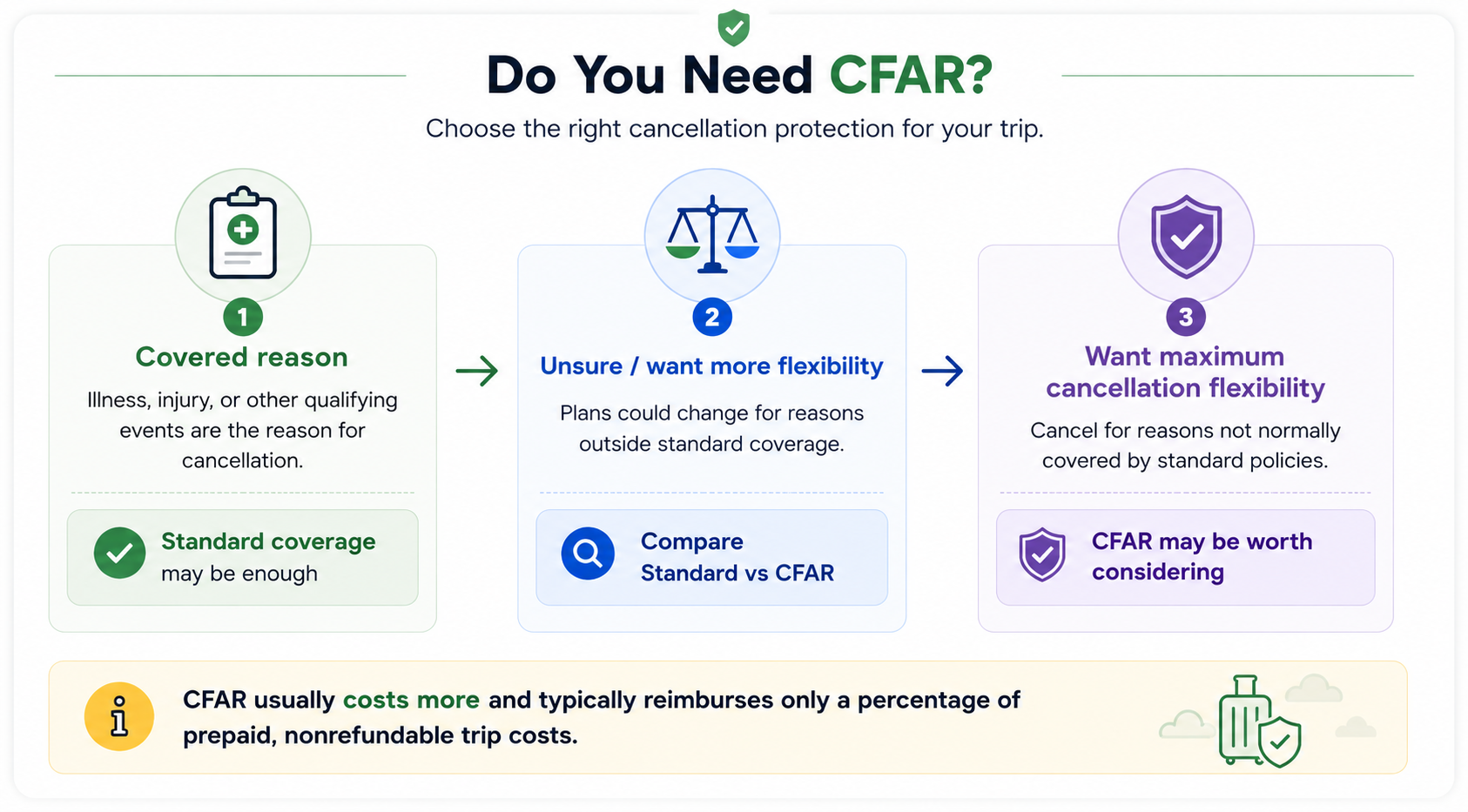
Standard travel insurance only reimburses a trip cancellation if the reason falls on a specific list of covered reasons defined in the policy, such as illness, injury, or a natural disaster at your destination. Cancel For Any Reason coverage, commonly shortened to CFAR, removes that restriction, allowing you to cancel for literally any reason, including simply changing your mind, and still receive a partial reimbursement. CFAR typically costs forty to sixty percent more than standard coverage and usually reimburses between fifty and seventy five percent of your trip cost rather than the full amount a standard covered reason claim would pay.
How Standard Travel Insurance Handles Cancellations
A standard policy operates on a covered reasons basis, meaning your reason for cancelling must specifically match one of the reasons listed in the policy for a claim to be paid. For the full breakdown of what a standard policy includes across every coverage category, not just cancellation, see what does travel insurance cover. Common covered reasons include illness or injury to you or a family member, a natural disaster affecting your destination, a traveling companion's illness, jury duty, and a handful of other specifically defined situations.
If your actual reason for cancelling does not appear on that list, even a reason that feels completely legitimate, a standard policy will deny the claim. This is the single most common source of frustration and confusion among travelers who assumed their policy would cover any reasonable cancellation, only to discover the specific list is narrower than expected.
Estimate Your Travel Insurance Cost
Use our free calculator to estimate potential costs for your planned travel.
Emily Foster writes insurance comparison content at InsuranceBlip. Her work explains costly decisions like minimum versus full coverage and term versus whole life, helping readers choose coverage based on their situation rather than guesswork.
CFAR is purchased as an upgrade to a standard policy, not as a standalone product, and it comes with its own specific requirements beyond simply paying a higher premium. Most insurers require CFAR to be purchased within a short window after your initial trip deposit, commonly fourteen to twenty one days, similar to the timing requirement for a pre-existing condition waiver. You must also typically insure the full non refundable cost of your trip, and cancel at least forty eight to seventy two hours before your scheduled departure, to remain eligible for the CFAR benefit.
In exchange for meeting these requirements, CFAR removes the covered reasons restriction entirely, allowing cancellation for any reason at all, whether that is a change of personal circumstances, general anxiety about a destination, or simply deciding you no longer want to take the trip. The tradeoff is that CFAR almost never reimburses the full trip cost the way a standard covered reason claim does, instead capping reimbursement at a percentage specified in the policy.
Real-World Scenarios
A standard covered reason claim.
A traveler cancels a trip five days before departure due to a documented illness. Since illness is a standard covered reason, the claim is paid at the full insured trip cost, and CFAR coverage would not have provided any additional benefit in this specific situation.
A CFAR claim that would have been denied otherwise.
A traveler decides to cancel a trip due to a change in work circumstances that does not fall under any standard covered reason. With CFAR properly purchased within the required window, the traveler cancels more than seventy two hours before departure and receives seventy five percent of their trip cost back, an outcome that a standard policy would have denied entirely, since a job related change of plans is not a typical covered reason.
A CFAR purchase that missed the deadline.
A traveler intends to add CFAR coverage but purchases their policy five weeks after their initial trip deposit, well outside the typical fourteen to twenty one day window most insurers require. When they later need to cancel for a reason outside the standard list, they discover CFAR was never actually active on their policy, since the purchase window requirement was missed, leaving them with only standard coverage and a denied claim.
Which Should You Choose?
Standard coverage is sufficient for most travelers whose realistic cancellation risks fall within the typical covered reasons list, particularly illness, injury, or a natural disaster, which cover the majority of real world cancellation scenarios. CFAR becomes worth the additional cost for travelers with less predictable circumstances, such as an uncertain work schedule, a destination they are personally uneasy about for reasons that would not qualify as a covered reason, or simply a strong preference for maximum flexibility regardless of the reason.
The timing requirement is the detail most travelers miss entirely. Since CFAR must typically be purchased within a narrow window after your initial deposit, deciding whether you want this coverage needs to happen early in your trip planning, not as an afterthought once a specific concern arises. For travelers weighing this alongside how often they travel overall, see single-trip vs annual travel insurance, since CFAR availability and terms can differ between the two policy structures.
CFAR generally adds forty to sixty percent to the cost of your base travel insurance premium. On a trip where standard coverage costs two hundred dollars, adding CFAR might bring the total to roughly two hundred eighty to three hundred twenty dollars, though the exact percentage varies by insurer and by your specific trip details.
What's the deadline to cancel under CFAR?
Most insurers require you to cancel at least forty eight to seventy two hours before your scheduled departure to qualify for the CFAR benefit. Cancelling within that final window before departure typically forfeits the CFAR benefit entirely, even though the coverage was properly purchased and active up to that point.
Does CFAR reimburse 100% of my trip cost?
No, almost never. CFAR reimbursement is capped at a percentage specified in the policy, commonly between fifty and seventy five percent of your total trip cost, rather than the full amount. This is one of the most commonly misunderstood aspects of CFAR, since travelers often assume the broader cancellation flexibility comes with the same full reimbursement a standard covered reason claim provides.
Flexibility at a Real Cost, Not a Free Upgrade
Cancel For Any Reason coverage solves a genuine limitation of standard travel insurance, the narrow list of covered reasons, but it comes with real tradeoffs of its own: a higher premium, a partial rather than full reimbursement, and strict timing requirements for both purchase and cancellation. Understanding those tradeoffs upfront, rather than assuming CFAR simply means unlimited full coverage for any situation, is what allows you to decide whether the additional cost genuinely matches your specific trip's uncertainty.
Use our free tools to estimate insurance costs before you shop. No personal information required just straight forward estimates.
Auto Insurance Calculator
Estimate your car insurance costs based on your age range, driving history, vehicle type, coverage level, & location. Understand how each factor affects your premium.
Life Insurance Needs Calculator
Calculate how much life insurance coverage your family might need based on your income, debts, and financial goals.
Health Insurance Estimator
Understand how premiums, deductible, out-of-pocket costs vary across different plans. Useful for comparing coverage options during enrollment or life change.
Business Insurance Estimator
Estimate general liability and small business insurance costs based on your industry, business size, and coverage needs.
Homeowners Insurance Calculator
Estimate how much homeowners insurance might cost based on your property value, location, and coverage needs.
Travel Insurance Calculator
Estimate trip protection costs based on your destination, trip duration, and the type of coverage you need.