Usually not, unless you specifically purchase a pre-existing condition waiver, which most insurers offer as an add on rather than including automatically in a standard policy. Without that waiver, a standard travel insurance policy will typically deny a claim related to a condition you had before purchasing the policy, even if the trip disruption itself, such as a hospital stay, feels entirely reasonable and unavoidable. For the full picture of what a standard policy includes and excludes overall, see what does travel insurance cover.
This exclusion catches many travelers off guard, particularly those managing a chronic but well controlled condition who assume their situation would obviously be covered if something went wrong. Insurers draw this line specifically because pre-existing conditions carry a materially higher, more predictable risk than an unexpected new illness or injury, and pricing that risk into every policy would raise costs for all travelers.
What Counts as a Pre-Existing Condition
Most insurers define a pre-existing condition broadly, covering any illness, injury, or medical condition for which you received treatment, medication, or a diagnosis within a specific look back period before purchasing your policy, commonly somewhere between sixty and one hundred eighty days depending on the insurer. This definition often surprises travelers, since it can include well managed chronic conditions such as high blood pressure or diabetes, not just serious or unstable diagnoses.
The look back period specifically examines whether you received treatment or a medication change during that window, rather than simply whether you have ever been diagnosed with a condition at any point in your life. A condition that has been completely stable with no treatment changes for years can sometimes fall outside the look back period entirely, while a recent adjustment to a long standing prescription can trigger the exclusion even for an otherwise well controlled condition.
Estimate Your Travel Insurance Cost
Use our free calculator to estimate potential costs for your planned travel.
Rachel Morgan covers insurance coverage analysis at InsuranceBlip. Her work examines the gap between what policies promise and what they actually pay out, helping readers understand their coverage before they ever need to use it.
A pre-existing condition waiver is an add on that specifically removes the standard exclusion, allowing claims related to a pre-existing condition to be covered as though they were a new illness or injury. This is not automatic on most policies and typically must be purchased as part of your initial policy purchase, or added within a short window afterward, rather than being something you can add later once a condition becomes relevant to your trip.
Standard Policy
Policy With Pre-Existing Condition Waiver
Covers new illness or injury
Yes
Yes
Covers pre-existing conditions
No
Yes, subject to waiver terms
Additional cost
None
Modest additional premium
Purchase window
Anytime before departure
Typically within 10 to 21 days of initial trip deposit
How to Qualify for the Waiver
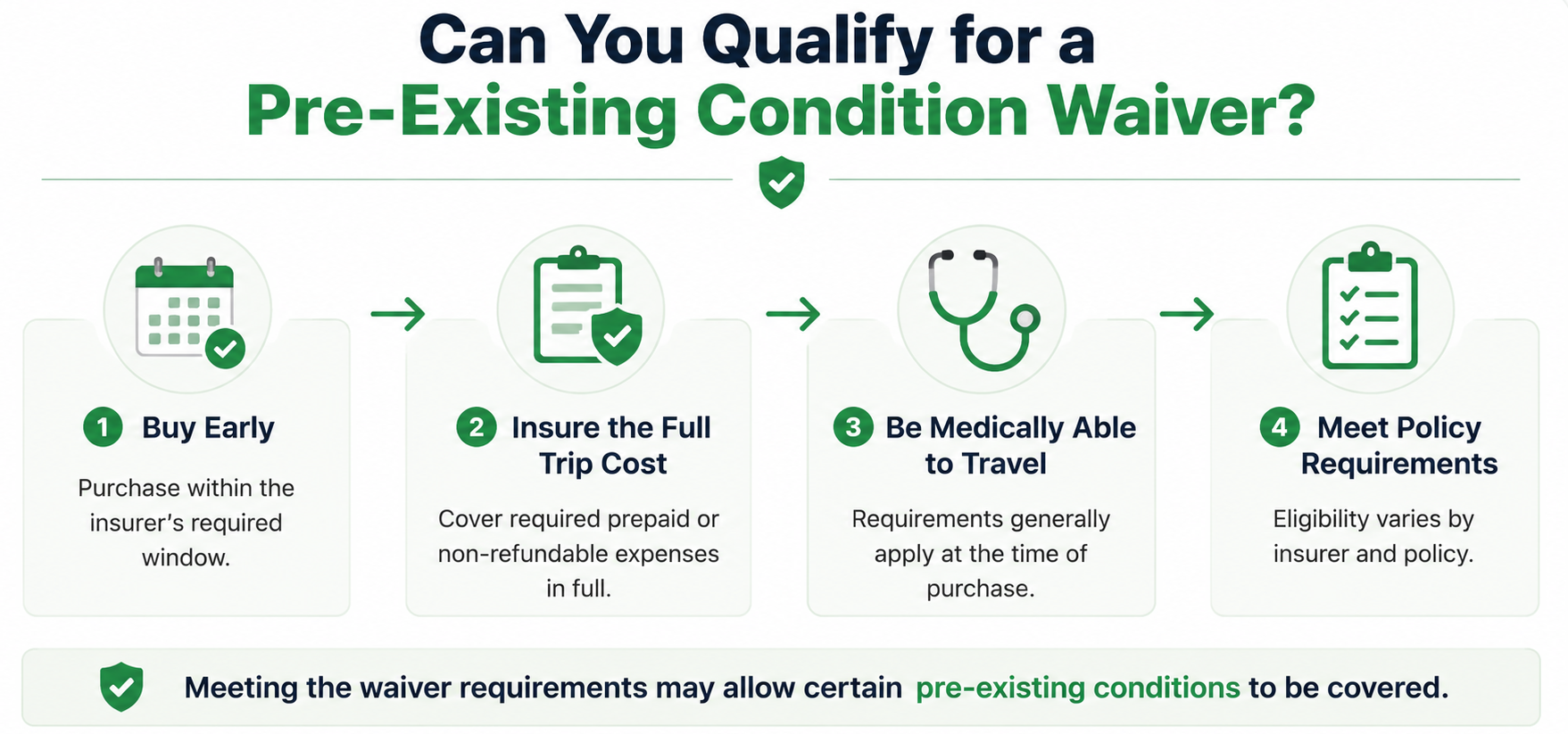
Insurers attach specific requirements to a pre-existing condition waiver, and missing any one of them typically voids the waiver even if you purchased it.
Purchase within the specified window.
Most insurers require the waiver be purchased within ten to twenty one days of your initial trip deposit, not at any point before departure.
Insure the full non refundable trip cost.
Many insurers require you to insure one hundred percent of your prepaid, non refundable trip costs to qualify for the waiver, not a partial amount.
Be medically able to travel at the time of purchase.
The waiver typically requires that you were not already advised against travel by a physician, hospitalized, or receiving a terminal diagnosis at the time you bought the policy.
Insure any traveling companions whose conditions could affect the trip.
Some policies extend this requirement to family members or travel companions, not just the policyholder, if that person's condition could reasonably disrupt the trip.
Common Scenarios
A waiver purchased correctly.
A traveler with a well managed heart condition books a trip and purchases travel insurance, including the pre-existing condition waiver, within the required window after their initial deposit. A cardiac event during the trip requires hospitalization, and because the waiver was properly purchased and all requirements were met, the medical expenses and trip interruption costs are covered as though the condition were a new illness.
A waiver missed by timing.
A traveler with the same condition purchases travel insurance three weeks after their initial trip deposit, missing the typical ten to twenty one day window most insurers require for the waiver. When a similar cardiac event occurs during the trip, the claim is denied specifically due to the pre-existing condition exclusion, since the waiver was never validly attached to the policy in the first place.
A condition outside the look back period.
A traveler with a condition that has required no treatment changes or new medication in over a year purchases a standard policy without a waiver. Because the condition falls outside the insurer's specific look back period and required no recent treatment, a related claim is evaluated as not pre-existing under that insurer's specific definition, illustrating why the exact look back period and its interpretation matters more than whether a condition exists at all.
What's the look-back period for pre-existing conditions?
This varies by insurer, but commonly falls between sixty and one hundred eighty days before your policy purchase date. During this window, insurers examine whether you received treatment, a diagnosis, or a medication change related to the condition in question, rather than simply whether the condition has ever existed.
Does CFAR help if I have a pre-existing condition?
Cancel For Any Reason coverage can provide a partial safety net, since it allows cancellation for reasons outside the standard covered list, potentially including a pre-existing condition related issue that a standard policy would deny. CFAR typically only reimburses a percentage of your trip cost, however, rather than the full amount a properly purchased pre-existing condition waiver would provide, making it a partial solution rather than a full substitute.
Do I need to disclose conditions when buying a policy?
Most travel insurance applications do not require you to disclose specific medical conditions upfront the way a life insurance application would. Instead, coverage for pre-existing conditions is determined at the time of a claim, based on your medical records and the policy’s look back period, rather than through a disclosure process at purchase. This makes purchasing the waiver correctly upfront more important than any disclosure step, since there typically is no separate disclosure step to rely on.
Timing and Requirements Matter More Than the Condition Itself
Whether a pre-existing condition ends up covered often comes down less to the condition itself and more to whether the waiver was purchased within the required window and whether every other qualifying requirement was met. Travelers managing any ongoing health condition should treat the waiver purchase window as a hard deadline tied to their trip deposit date, not a flexible option to revisit later. For more on how travel insurance policy types interact with this decision, see single-trip vs annual travel insurance.
Use our free tools to estimate insurance costs before you shop. No personal information required just straight forward estimates.
Auto Insurance Calculator
Estimate your car insurance costs based on your age range, driving history, vehicle type, coverage level, & location. Understand how each factor affects your premium.
Life Insurance Needs Calculator
Calculate how much life insurance coverage your family might need based on your income, debts, and financial goals.
Health Insurance Estimator
Understand how premiums, deductible, out-of-pocket costs vary across different plans. Useful for comparing coverage options during enrollment or life change.
Business Insurance Estimator
Estimate general liability and small business insurance costs based on your industry, business size, and coverage needs.
Homeowners Insurance Calculator
Estimate how much homeowners insurance might cost based on your property value, location, and coverage needs.
Travel Insurance Calculator
Estimate trip protection costs based on your destination, trip duration, and the type of coverage you need.