

Compare minimum liability coverage against full coverage for your specific vehicle and see the real cost and risk difference.
Estimate both coverage levels side by side based on your vehicle and driving profile. No personal information required.
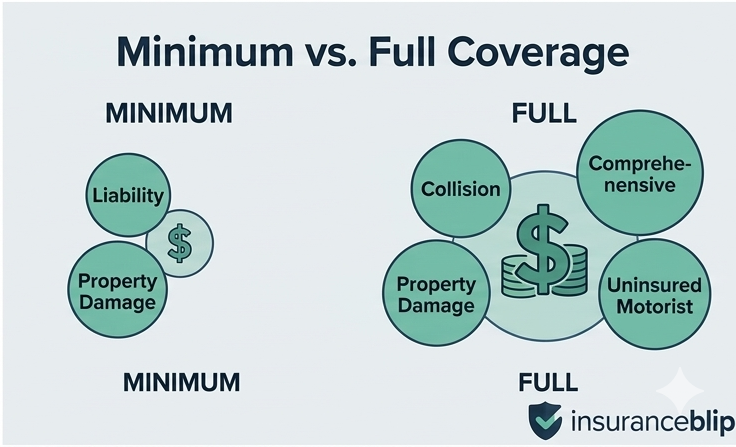
State-required liability protection and other mandatory coverages, without collision and comprehensive.
Typically combines liability with collision and comprehensive coverage, subject to deductibles and policy terms.
How
This tool estimates the cost difference between your state's minimum required liability coverage and full coverage, which adds collision and comprehensive protection for your own vehicle.
Minimum coverage satisfies your state's legal requirement and covers damage you cause to others, but pays nothing toward your own vehicle if you cause an accident, hit an object, or experience theft or weather damage. Full coverage adds that protection, at a higher premium, and is typically required by lenders and leasing companies for as long as a loan or lease is active.
The calculator does not require personal information and does not generate quotes from insurance companies.
Factors
Why
Insurers price both minimum and full coverage using their own underwriting models, and identical driver profiles can receive different quotes between companies. This tool provides a directional estimate to guide your decision before requesting real quotes.
When
Using this tool before making a coverage change helps you see the actual dollar tradeoff clearly, rather than dropping full coverage based on the premium savings alone without weighing what you’d be giving up.
Related Tools
Explore our featured tools related to auto insurance.
Get a personalised monthly premium estimate based on your age, driving history, vehicle type, coverage level, and location.
Answer 5 quick questions about your driving habits and profile to find which auto insurance discounts you currently qualify
See exactly how changing your deductible from $500 to $1,000 or $1,500 affects your monthly premium — before you decide.
Auto Insurance Special
The table below illustrates typical monthly premium differences between minimum and full coverage across vehicle age tiers.
| Vehicle Age | Minimum Coverage | Full Coverage | Approx. Gap |
|---|---|---|---|
| 0–3 years old | $45–$70/mo | $130–$210/mo | $85–$140/mo |
| 4–7 years old | $40–$65/mo | $95–$150/mo | $55–$85/mo |
| 8–12 years old | $35–$55/mo | $65–$100/mo | $30–$45/mo |
| 13+ years old | $30–$50/mo | $45–$70/mo | $15–$20/mo |
Note: These figures illustrate typical proportional patterns, since full coverage’s cost premium narrows as vehicle value depreciates. Actual costs depend on your specific vehicle, state, insurer, and driving record.
A commonly cited rule of thumb is that if your annual full coverage premium exceeds about 10 percent of your vehicle’s current value, it may be worth reconsidering, since the maximum possible payout is capped at that value regardless of how much you pay in premiums over time.
Generally yes, once your vehicle is paid off and no longer subject to a lender’s coverage requirement. You can typically make this change at your next renewal or by contacting your insurer directly.
It covers the other driver’s injuries and property damage up to your state’s required limits, but pays nothing toward your own vehicle’s damage or your own injuries beyond what your state’s specific minimum requirements include, such as PIP in no-fault states.
No. Both the cost of minimum coverage and the size of the gap to full coverage vary significantly by state, driven by differing minimum requirement levels and regional risk factors.
You would remain responsible for the remaining loan balance with no insurance payout toward the vehicle itself, since minimum coverage doesn’t cover your own vehicle at all. This is the primary reason lenders require full coverage.
Yes, to a degree. Raising your collision and comprehensive deductibles lowers your full coverage premium while keeping the underlying protection intact, narrowing the cost gap without giving up coverage entirely.
Related Guides
Looking for more in-depth answers? Explore our latest auto insurance guides covering costs, coverage options, policy comparisons, and expert tips.
You may also find these tools helpful:
© 2026 InsuranceBlip. All rights reserved. Website created & managed by Infolytics.