

The Full Breakdown by Industry, State, and What You Can Control
Workers comp insurance cost typically runs between $0.20 and $15.00 per $100 of payroll, depending almost entirely on your industry's risk classification, with office jobs sitting near the bottom of that range and construction and trades sitting near the top. For a business with $500,000 in annual payroll, that translates to anywhere from around $1,000 a year for low-risk office work to well over $50,000 a year for high-risk construction, a genuinely enormous spread for what sounds like one insurance category. If you're not sure whether your business is even required to carry it, see is business insurance required first.
The rest of this guide breaks down exactly why that spread exists, what you can actually influence, and what a real calculation looks like for a specific business.
Workers' compensation is a no-fault insurance system, meaning it pays medical costs and partial lost wages to an employee injured on the job regardless of who was at fault for the injury, in exchange for the employee generally giving up the right to sue their employer directly over that injury. This tradeoff is the foundation of the entire system: employers get protection from potentially catastrophic lawsuits, and employees get a faster, more certain path to medical care and wage replacement than a lawsuit would provide.
Workers' compensation is regulated at the state level, not federally, which means the specific rules, required minimum coverage, and even how premiums are calculated vary meaningfully depending on where your business operates. Most states require coverage the moment you hire your first employee, though a handful of states allow exceptions for very small businesses or specific industries. For the full picture of how workers' comp fits alongside your other business coverage, see what is business insurance.
Table of Contents

Covers the full cost of treatment for a work-related injury or illness, including emergency care, surgery, and ongoing treatment.
Replaces a portion of an injured employee's wages, commonly around two-thirds, while they're unable to work.
Provides ongoing benefits if an injury results in temporary or permanent disability affecting the employee's ability to work.
Provides financial support to a deceased employee's dependents if a workplace injury results in death.
Covers physical therapy and vocational rehabilitation needed to help an injured employee recover or return to work.
Covers legal costs if a workers' compensation claim is disputed or results in a hearing.
The single largest factor in workers' comp pricing is your industry's classification code, which reflects the inherent injury risk of the work being performed. The table below shows typical rates per $100 of payroll across broad risk categories.
| Industry Classification | Typical Rate per $100 Payroll | Annual Cost on $500,000 Payroll |
|---|---|---|
| Office / Low Risk | $0.20–$0.60 | $1,000–$3,000 |
| Retail / Service | $0.80–$2.00 | $4,000–$10,000 |
| Manufacturing | $2.50–$6.00 | $12,500–$30,000 |
| Transportation | $3.50–$8.00 | $17,500–$40,000 |
| Construction / Trades | $5.00–$15.00+ | $25,000–$75,000+ |
The gap between the top and bottom of this table is enormous, over twenty times, purely because of the underlying physical risk difference between an office job and a construction job. This is why accurately classifying your employees' actual job duties matters so much: misclassifying a lower-risk role under a higher-risk code, or vice versa, can meaningfully overpay or underpay relative to your real risk profile.
Because workers' compensation is regulated at the state level, identical businesses in different states can pay noticeably different rates for the same coverage. States set their own base rate structures, and some states use a competitive private insurance market while others rely partly or entirely on a state-run fund. A few states also have significantly higher medical cost environments, which flows directly into higher workers' comp premiums, since medical treatment is the largest single cost driver behind most claims.
There's no substitute for checking your specific state's current base rates directly, since these figures are set and adjusted through state regulatory processes that change over time. Your insurer or a licensed commercial broker can provide the exact current classification rates for your state and industry.
Beyond industry and state, several other factors shape your final premium.
In simplified terms, workers’ compensation pricing starts with payroll and the rate assigned to your job classification, then adjusts that base amount using factors such as claims experience. The example below shows how those pieces can work together.



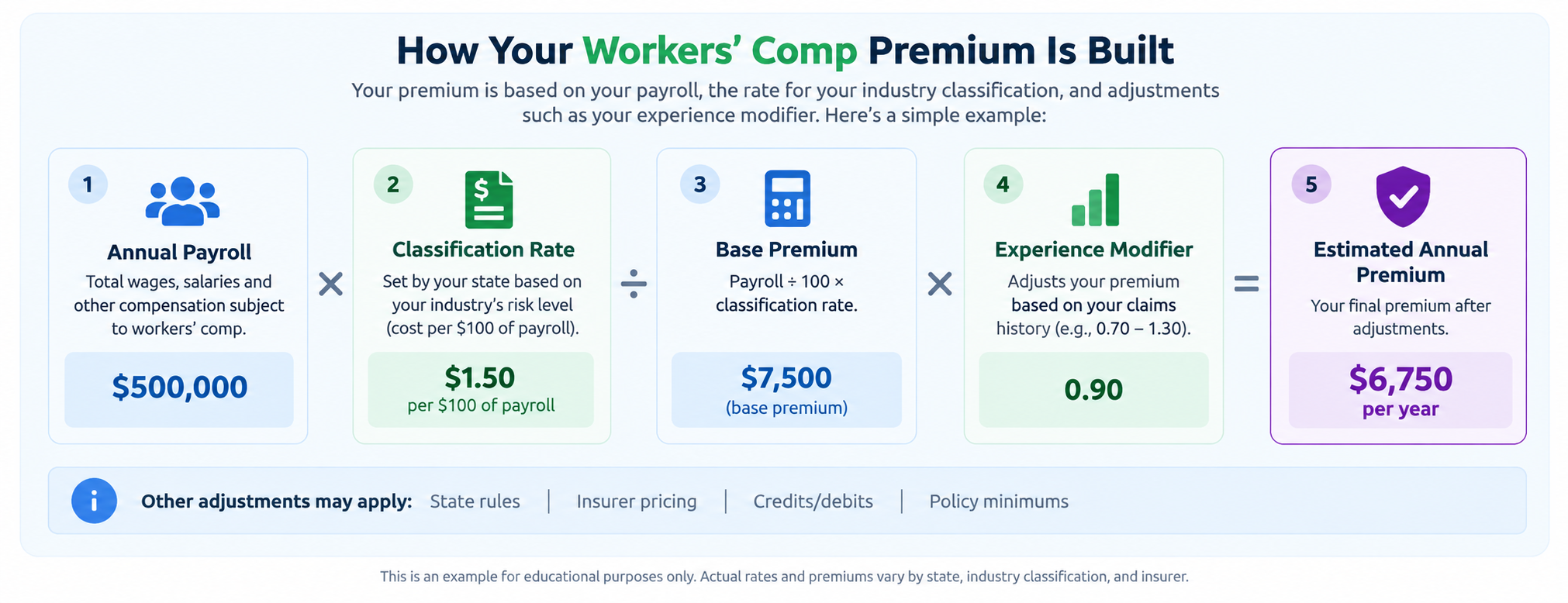
Consider a construction business with fifteen employees and an annual payroll of $750,000. Based on a typical construction classification rate of $8.00 per $100 of payroll, the base premium calculation starts at $60,000 a year.
This business has maintained a clean claims history for the past three years, qualifying for an experience modifier of 0.85, a discount reflecting better-than-typical claims performance for their industry. Applying that modifier brings the premium down to $51,000 a year. The business also implements a documented safety program that qualifies for an additional five percent credit with their specific insurer, bringing the final premium to approximately $48,450 a year.
Compare this to a similarly sized office-based consulting firm with the same $750,000 payroll. At a typical office classification rate of $0.40 per $100 of payroll, their base premium is just $3,000 a year, before any modifier adjustments, illustrating just how much industry classification alone drives the final number, far more than payroll size or claims history alone ever could.
Several concrete steps can meaningfully reduce what you pay over time. Accurately classifying every employee's actual job duties, rather than defaulting to a higher-risk code out of caution, ensures you're not overpaying relative to your real risk. Maintaining a strong safety record directly improves your experience modifier over time, and the effect compounds, a business that stays claims-free for several consecutive years often sees a meaningfully lower modifier than one with even a single significant claim.
Implementing a documented workplace safety program, including regular training and clear incident reporting procedures, can unlock direct premium credits with many insurers, separate from the experience modifier benefit. Reviewing your payroll allocation across classification codes at each renewal, rather than letting it default to prior year figures, ensures your premium reflects your current actual workforce composition, not an outdated one. Finally, comparing quotes from multiple insurers at renewal, ideally through a broker who specializes in your industry, is worth doing even if you're satisfied with your current coverage, since workers' comp pricing can vary meaningfully between insurers for the same risk profile.
In most states, yes, once you hire your first employee, though a handful of states allow exceptions for very small businesses or specific industries. Requirements and thresholds vary by state, so confirming your specific state’s rules directly with your state’s labor department or a licensed broker is worth doing rather than assuming a general rule applies.
The pricing reflects genuine, well-documented differences in injury frequency and severity between industries. Construction and trades involve significantly higher physical risk, more severe injuries when they occur, and correspondingly higher claim costs, all of which flow directly into the classification rate for that industry.
An experience modifier compares your business’s actual claims history to what’s typical for your industry and payroll size, adjusting your base rate up or down accordingly. It’s typically calculated using a rolling multi-year lookback period, meaning a single claim can affect your modifier, and therefore your premium, for several years after the claim itself was resolved.
Yes, several legitimate strategies exist without reducing actual protection: accurate job classification, documented safety programs, maintaining a clean claims history over time, and comparing quotes across insurers all reduce cost without leaving your business or employees less protected.
Premium is calculated based on actual payroll, so part-time employees generally cost proportionally less in premium than full-time employees in the same classification, since their total payroll contribution is smaller, not because of a different rate structure.
At every renewal, at minimum, and immediately after any significant change in job duties, staffing, or business operations. An outdated classification or payroll allocation is one of the more common and easily correctable sources of overpayment.
Workers' compensation cost varies more dramatically by industry than almost any other business insurance category, a difference of twenty times or more between a low-risk office job and high-risk construction work for the same payroll amount. Understanding your specific classification, keeping it accurate as your business changes, and maintaining a strong safety record over time are the levers genuinely within your control, everything else follows from the underlying risk profile your industry represents. Get a personalized estimate below based on your specific industry, payroll, and state.
Get a personalized estimate based on your specific industry, payroll, state, and claims history.
Try Workers Comp Rate CalculatorExplore Insurance GuidesAt A Galance
Use our free tools to estimate insurance costs before you shop. No personal information required just straight forward estimates.
Estimate your car insurance costs based on your age range, driving history, vehicle type, coverage level, & location. Understand how each factor affects your premium.
Calculate how much life insurance coverage your family might need based on your income, debts, and financial goals.
Understand how premiums, deductible, out-of-pocket costs vary across different plans. Useful for comparing coverage options during enrollment or life change.
Estimate general liability and small business insurance costs based on your industry, business size, and coverage needs.
Estimate how much homeowners insurance might cost based on your property value, location, and coverage needs.
Estimate trip protection costs based on your destination, trip duration, and the type of coverage you need.
© 2026 InsuranceBlip. All rights reserved. Website created & managed by Infolytics.